Hot Topics for BFCM 2026: What You Need to Know in the Age of AI
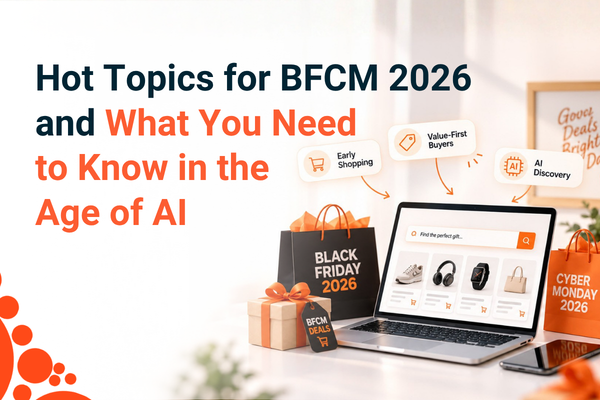
How early shopping, value-first buyers, and AI discovery are rewriting the peak season — and how on-site search like brng.ai keeps shoppers on your store.
BFCM 2026 is no longer a weekend. It is a season — and the store that wins is the one that answers the question the shopper already asked an AI.
Black Friday 2026 is Friday, November 27. Cyber Monday is Monday, November 30. Thanksgiving is Thursday, November 26. That four-day stretch still matters. It is no longer the whole story.
Shoppers are planning in late summer, buying in October and early November, and still shopping after Cyber Monday. Brands that treat BFCM as a 72-hour fire sale will miss demand that arrives before the deals and demand that lingers after them. They will also miss the shopper who already compared three options in ChatGPT and will bounce if your on-site search cannot finish the conversation.
Here is what actually matters this year — and how on-site AI search, including tools like brng.ai, turns that traffic into time on site and orders.
The event became a season
Attentive’s June 2026 survey of 600 U.S. shoppers planning to shop BFCM found that 71% intend to start purchasing before Black Friday, and 46% before November even begins. Eighty-four percent expect deals before Black Friday itself, almost entirely in November. After BFCM 2025, 83% still had end-of-year purchases left.
That matches what operators already saw. Leading DTC brands have been launching holiday promotions weeks before Black Friday and extending them into December. In 2025, Triple Whale brands generated $1.77 billion and 16.6 million orders in the pre-BFCM window. Waiting until Friday morning is paying peak CPMs for leftover audience.
Call it Black November. The practical implication is a calendar, not a weekend: early-bird and VIP access in early November, member weeks mid-month, Thanksgiving as the opening bell, Black Friday as the peak, Cyber Monday as a refresh, and a long tail into December.
Value beat deepest discount
The economy is still setting the terms. Eighty-seven percent of Attentive respondents said it will change how they shop. Forty-two percent will compare brands more. Forty-one percent will focus on needs over wants. Thirty-nine percent will stock up on regular-use items while they are discounted. Budgets are holding, not exploding: 23% plan to spend more than last year, 45% about the same, 25% less.
Four in five shoppers would buy at 40% off or less. The strongest non-discount levers are free shipping (68%), gift with purchase (42%), price-match (39%), and extra loyalty points (35%). Price-drop alerts on items they already care about would make 90% more likely to buy. A discount on something recently viewed or carted would move 88%. Relevant product recommendations would move 73%.
Sitewide slashing is a blunt instrument. Selective offers, tiers, bundles, and spend thresholds that lift average order value fit this shopper better than a race to the bottom.
AI is already in the purchase path
Two-thirds of Attentive’s shoppers (67%) have used tools like ChatGPT, Gemini, or Perplexity to help with shopping in the past three months. Among Gen Z, that share is 80%. Primary jobs: questions about a specific product (58%), comparing brands and features (51%), recommendations (45%), and finding deals (43%). AI users were far more likely to spend more than planned last BFCM (68% vs. 25% of non-users). Adobe data from the 2025 holidays showed generative-AI referrals to U.S. retail sites up roughly 693% year over year, converting about 31% better than other traffic, staying longer, and bouncing less.
Salesforce’s 2026 outlook: about 20% of holiday e-commerce traffic will originate from AI chat agents. One in three e-commerce sites is expected to have a site-specific shopper agent live by Cyber Week. General assistants win early — gift lists, comparisons, promo hunting. Brand-owned experiences win when the question is inventory, fit, returns, or “what in this catalog matches what I just asked.”
That last point is the gap most stores still have. Shoppers arrive already researched. Keyword search and filter trees cannot finish the job.
How brng.ai makes products easier to find — and keeps people on the site
Public models can send a shopper to your homepage. They cannot reliably search your catalog in the shopper’s own words. That is the job of on-site natural language search.
brng.ai is an AI search and discovery layer for websites and ecommerce stores — Shopify, Magento, WooCommerce, WordPress, and custom stacks. It ingests products, collections, metafields, tags, prices, availability, and storefront content, then lets visitors ask the way they already talk to ChatGPT.
Instead of guessing SKU language or clicking through filters, a shopper can type:
- waterproof jacket for fall hiking under $200
- gift for my mom who loves gardening
- something like the Sierra Shell but warmer
- vegan running shoes for wide feet under $150
- what’s the difference between the Pro and the Lite?
brng.ai maps intent — budget, occasion, fit, materials, use case — to the attributes already in the catalog and returns grounded answers from real specs, descriptions, and reviews rather than generic chat. Comparisons and content-aware answers keep the shopper in a conversation on your domain instead of bouncing back to Gemini to finish the research.
That is how dwell time goes up. Poor search is a leak: a large share of shoppers leave after a bad search, and a large share of zero-result searches still had products in stock. Natural language search recovers those queries. RAG-grounded answers give people a reason to read, compare, and click a second product instead of exiting. Analytics on the actual phrases people type then tell merchandisers what to stock, how to write PDP copy, and where the catalog has gaps — useful in a season when 42% of shoppers say they will compare more.
For BFCM specifically, that pairing is the point. AI-referred visitors convert better if the site can match the way they already searched. A branded search widget that understands “gift under $50 that ships before December 20” is how you keep the traffic arriving from agents from bouncing after one failed keyword search. Fast setup — catalog sync, branded widget, no theme rewrite on Shopify — matters because the season has already started.
Make the catalog machine-readable either way. If an assistant — on-site or off-site — cannot extract specs, availability, sizing, shipping, and price, it will recommend a competitor.
Social commerce and the store still close the loop
Salesforce expects social commerce to be the fastest-growing transaction channel this holiday. Social purchases already rose 17% year over year in their data. Gen Z in particular plans to shop inside social apps. Physical stores remain a preferred holiday channel for many and often close a journey that started in a chat. A large share of holiday dollars will be hybrid: digital research, AI tools, or mobile plus a store.
Inventory, pricing, and customer history have to be consistent across site, social shop, marketplace, and store. Owned channels still punch above their weight when paid CAC spikes. Early-access and item-alert sign-ups match this year’s shopper: 93% of Attentive respondents said they would subscribe before Cyber Week for the right hook.
What to do before November
Build a season-long plan from September list growth through December retention. Offer moderate discounts plus free shipping, gifts, or loyalty value. Load-test checkout. Keep inventory accurate in every channel.
Then close the discovery gap. Structure product data. Put natural language search on the storefront so the question a shopper asked ChatGPT can be answered again — accurately — on your site. Use query analytics to merchandise the next wave of gifts and essentials. Treat first-time BFCM buyers as the start of a relationship, not a coupon event.
BFCM 2026 will reward the brands that showed up early, priced with discipline, and made themselves easy to find — by a person and by the AI that person asked first. On-site search that understands intent is how you keep that person long enough to buy.
Sources include Attentive’s 2026 BFCM Shopper Report, Salesforce 2026 holiday predictions, Adobe Digital Insights (2025 holiday AI traffic), Triple Whale BFCM 2026 checklist, and Klaviyo 2026 BFCM research. Figures are from published 2025–2026 industry reports and surveys as of September 2026.