
How to Make Your Website AI-Ready for the Future of Search
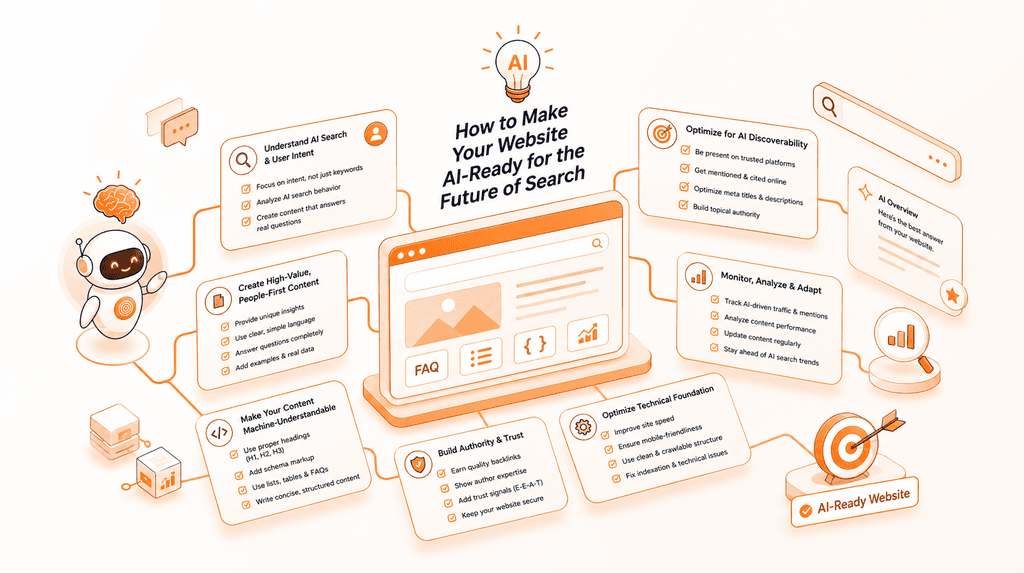
- Understand relationships between information
- Interpret meaning accurately
- Surface relevant answers to users
Unlike traditional search engines that rely heavily on indexing, AI systems attempt to process and understand content contextually.
This requires:
- Structured content
- Clear formatting
- Semantic organization
- Accessibility optimization
- Consistent metadata
Many older websites were never designed with AI consumption in mind.
As a result, organizations often discover that their content is difficult for AI systems to interpret effectively.
Understanding the llms.txt File
One of the emerging components of AI optimization is the llms.txt file.
Many website owners are already familiar with robots.txt, which tells search engines which areas of a website can or cannot be indexed.
The llms.txt file serves a similar purpose for AI systems.
It helps guide AI bots and large language models when they access and interpret website content.
Without this file, businesses may limit how effectively AI systems understand their websites.
The good news is that implementing an llms.txt file is relatively straightforward.
Organizations can:
- Create the file manually
- Use AI tools to generate it
- Work with agencies to implement it properly
Once configured correctly, the file becomes part of the website’s AI-readiness infrastructure.
Why Structured Content Matters
AI systems do not simply “read” websites the same way humans do.
They process information by:
- Breaking content into chunks
- Embedding contextual meaning
- Vectorizing information
- Building mathematical representations of concepts
This process allows AI systems to connect related ideas and deliver highly contextual responses.
For businesses, this means content structure matters more than ever.
Websites should prioritize:
- Clear headings
- Well-organized paragraphs
- Descriptive product information
- FAQ sections
- Consistent terminology
- Accessible formatting
The goal is to help AI systems understand not just what your content says, but what it means.
The Rise of AI-Readable Mirror Sites
For organizations with large amounts of content, manually rewriting everything for AI compatibility can feel overwhelming.
This is where AI-readable mirror sites are becoming increasingly valuable.
A mirror site acts as an AI-optimized version of your existing website.
Instead of replacing your current website, the mirror continuously transforms your content into a structured format designed specifically for AI ingestion.
Benefits include:
- Automatic AI-friendly formatting
- Continuous updates
- Improved discoverability
- Better contextual understanding
- Reduced manual effort
This approach allows businesses to maintain their existing website while simultaneously improving AI accessibility.
For ecommerce organizations managing large product catalogs, training materials, memberships, or educational resources, this can dramatically improve scalability.
Why Ecommerce Sites Need Better Content Organization
Modern ecommerce websites often include:
- Product catalogs
- Blogs
- Landing pages
- Membership systems
- Learning management systems
- Subscription platforms
- Knowledge bases
These systems frequently operate independently.
AI platforms may struggle to connect information across disconnected systems unless the website architecture is properly optimized.
This creates gaps in discoverability.
An AI-ready strategy ensures that all areas of the website can be understood cohesively.
The result is a more connected digital experience for both users and AI systems.
Budgeting for the AI Era
One of the realities businesses must accept is that AI optimization requires investment.
Organizations are now navigating:
- AI subscriptions
- Token-based pricing models
- AI infrastructure costs
- Cybersecurity upgrades
- Accessibility compliance
- Privacy regulations
Many businesses are also discovering that older websites require modernization to remain competitive.
However, the cost of ignoring AI optimization may ultimately be far greater.
Brands that fail to adapt risk losing visibility as user behavior shifts toward AI-powered discovery platforms.
Additional Areas Businesses Should Prioritize
Beyond AI optimization, organizations should also review:
Accessibility Compliance
Accessibility standards continue evolving, and businesses must ensure their digital properties remain compliant.
Cybersecurity
Website attacks and ecommerce security threats continue increasing.
Organizations should review:
- Cybersecurity policies
- Insurance coverage
- Platform updates
- Security monitoring
Cookie Consent and Privacy Policies
State-level privacy laws are expanding rapidly.
Businesses selling products or services across multiple states should ensure their cookie consent systems remain compliant with current regulations.
Preparing for the Future
AI-driven search is no longer experimental.
It is becoming a core part of how consumers discover products, research brands, and interact online.
Businesses that proactively invest in AI readiness today will be significantly better positioned for the future.
The organizations that thrive in the next generation of digital marketing will be those that:
- Embrace AI optimization early
- Improve content structure
- Prioritize accessibility
- Modernize website infrastructure
- Focus on authentic customer experiences
The future of search is evolving quickly — and AI-ready websites will become the new standard.
More Articles
All Articles
Stories
Custom GPTs, AI Chatbots, and the Future of Customer Engagement
May 19, 2026
How to Make Your Website AI-Ready for the Future of Search
What Is Answer Engine Optimization (AEO) and Why It Matters for Ecommerce